0. Introduction: Why Talk About AI and Drug Discovery Now?
The term “AI-driven drug discovery” has become ubiquitous.
Across pharmaceutical companies, startups, investors, and the media, it is spoken as if the future has already arrived.
Yet, among those who have spent years in drug discovery, a quiet sense of unease often remains.
Is AI truly transforming drug discovery?
Or have expectations begun to outpace reality?
This article is not written to dismiss AI in drug discovery.
Rather, it aims to revisit the fundamental nature of drug discovery itself, as a necessary step toward understanding what AI can—and cannot—do.
1. The Powerful Magnetism of the Term “AI Drug Discovery”
The phrase “AI drug discovery” carries an unusually strong appeal.
It combines artificial intelligence, medicine, and innovation into a single, compelling narrative.
This is not the result of bad intent.
The term is convenient for startups, reassuring for investors, and attractive for corporate storytelling.
As a result, the language often travels faster than the underlying definitions of success or progress.
This phenomenon is not unique to drug discovery. It is a familiar pattern in the early phases of technological change.
2. Why Generative AI Produces “Plausible” Answers
Generative AI excels at identifying patterns across vast datasets and recombining them into coherent outputs.
This capability allows it to generate responses that appear highly convincing.
In drug discovery, however, plausibility can be misleading.
Breakthroughs rarely emerge from average solutions. They arise from exceptions.
While AI is effective at producing statistically reasonable answers, identifying meaningful outliers remains largely a human responsibility.
3. What Defines High-Quality Data in Drug Discovery?
Data abundance does not equal data quality.
In drug discovery, datasets are heavily biased toward successful outcomes.
Crucial context—why an experiment was designed a certain way, why it failed, or why results were discarded—is rarely captured.
AI can learn from structured outcomes, but not from the reasoning that led to critical decisions.
4. The Eye for Drug Discovery and the Eye for Tuna
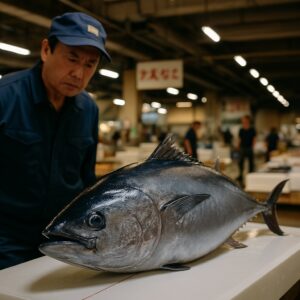
A high-quality tuna cannot be selected by numbers alone.
Price, origin, and volume offer clues, but true judgment depends on texture, color, fat distribution—and subtle discomfort.
Drug discovery is remarkably similar.
Physicochemical properties and activity data matter, but experienced practitioners also sense when data feels “too clean” or unreliable.
AI processes numbers.
It does not feel unease.
5. Decisions AI Struggles to Make
Drug discovery is a sequence of decisions.
Proceed or stop. Invest further or walk away.
These decisions involve science, time, capital, organizational constraints, and regulation.
Integrating these dimensions into a single judgment remains beyond current AI capabilities.
6. Why AI Still Matters in Drug Discovery
None of this diminishes the value of AI.
AI expands search spaces, accelerates hypothesis generation, and supports human reasoning.
The challenge lies in clarifying what we expect AI to do—and what we should not.
7. Have We Truly Understood Drug Discovery Itself?
AI is not the reason drug discovery is difficult.
Drug discovery has always been a low-reproducibility, experience-driven endeavor.
In many ways, AI has simply exposed this reality more clearly.
8. Conclusion: AI Drug Discovery as a Question, Not an Answer
AI drug discovery is not an answer.
It is a question—about how deeply we understand drug discovery itself.
Just as the ability to select a great tuna requires years of experience, so too does the ability to judge promising science.
Algorithms alone cannot replace this craft.
If we can begin by having a deeper conversation about what drug discovery truly entails, then AI may finally find its rightful place within it.
日本語版はこちら: AIと創薬 ― 流行語の向こう側で、いま本当に問われていること